The AI Dilemma in E-commerce: Wrapper APIs vs. Self-Hosted LLMs
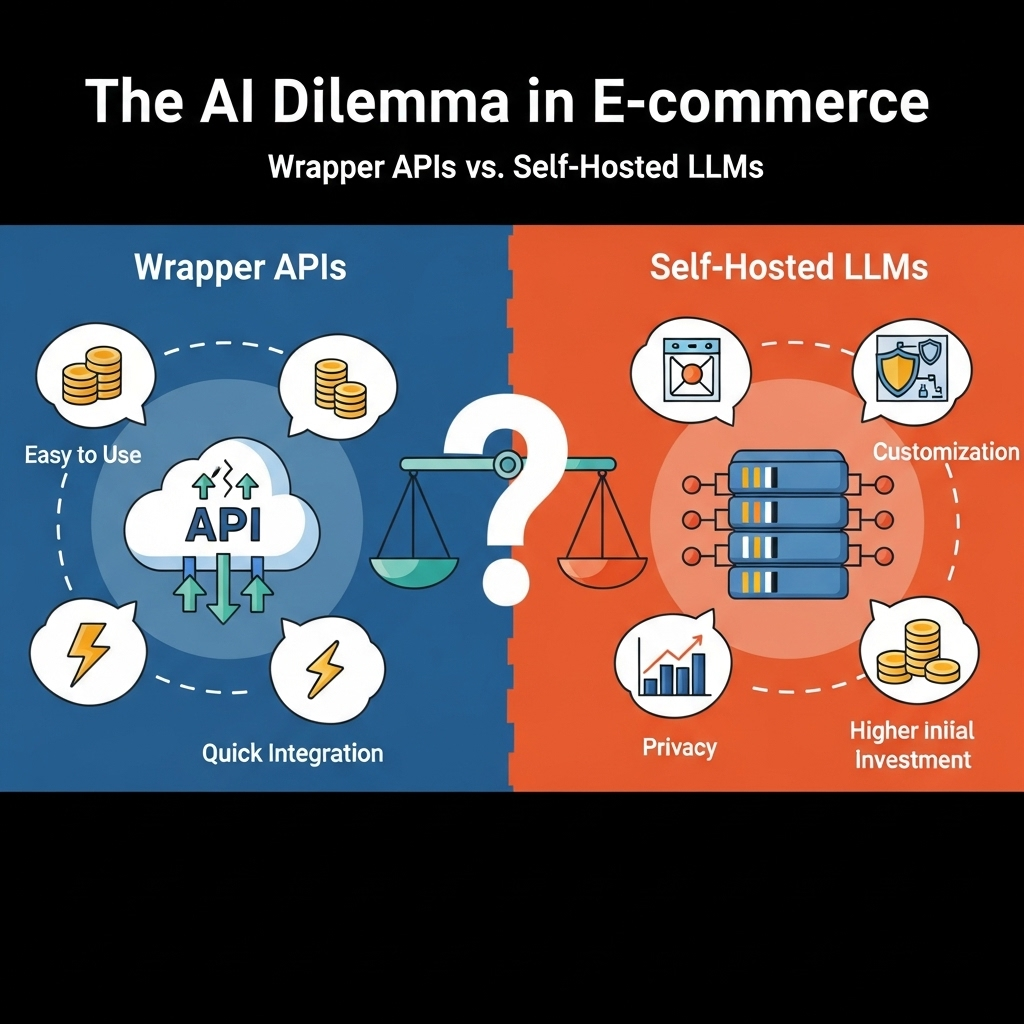
The AI Dilemma in E-commerce: Wrapper APIs vs. Self-Hosted LLMs
As developers, we're constantly weighing trade-offs. One of the biggest questions for e-commerce companies today is how to integrate generative AI: Do we use a powerful, off-the-shelf API like OpenAI's or Google's Gemini, or do we roll up our sleeves with a fine-tuned open-source model?
The answer isn't about which is "better," but which is right for your specific use case, budget, and team. Let's break it down by the two factors that matter most: Cost and Latency.
Option 1: The 'Plug-and-Play' Path — Wrapper APIs (OpenAI, Gemini, etc.)
This is the fastest way to get a powerful AI feature, like a product description generator or a customer service chatbot, up and running.
-
💰 Cost:
- Model: Pay-per-use (e.g., per 1,000 tokens). This is an Operational Expense (OpEx).
- Pros: Low initial investment. No need to manage complex infrastructure. Predictable costs at low volume.
- Cons: Costs can scale exponentially with high traffic. At a certain point, paying per API call becomes more expensive than hosting your own model.
-
⏱️ Latency:
- Model: You are subject to the provider's network traffic and server load.
- Pros: Generally low and highly optimized by world-class teams.
- Cons: Can be unpredictable. You have no direct control over performance spikes. A network hop to an external service will always be slower than an internal call.
Best for: Startups, MVPs, teams validating a new feature, or applications where cost at scale is not yet a concern and millisecond-level latency isn't critical.
Option 2: The 'DIY' Powerhouse — Fine-Tuned Open-Source LLMs (Llama 3, Mistral, etc.)
This path involves taking a powerful open-source model and fine-tuning it on your own data, hosted on your own infrastructure.
-
💸 Cost:
- Model: The model itself is "free," but this is a Capital Expense (CapEx) and ongoing engineering cost.
- Pros: Can be significantly cheaper at high volume. You are not paying a third party for every single request.
- Cons: Requires significant upfront investment in GPU infrastructure (renting or buying) and, more importantly, specialized engineering talent to set up, fine-tune, and maintain the models.
-
⚡ Latency:
- Model: You have complete control.
- Pros: You can achieve ultra-low latency by co-locating the model with your application servers. This is a game-changer for real-time features like AI-powered search-as-you-type or instant personalization.
- Cons: Performance is entirely your responsibility. Poor optimization can lead to worse latency than a commercial API.
Best for: Mature companies with high traffic, applications requiring real-time responses, businesses with strong data privacy requirements, or those with a dedicated AI/ML engineering team.
The Verdict
There's no one-size-fits-all answer.
- Choose Wrapper APIs for speed to market and to prove a concept with minimal upfront investment.
- Choose Open-Source for long-term cost savings at scale, unmatched control, and superior performance for latency-sensitive features.
As a developer exploring the AI space, I find this trade-off fascinating. It's a strategic decision that balances immediate needs with long-term vision.
I'm curious to hear from other developers and business leaders—what's your approach, and what factors drove your decision?
#AI #Ecommerce #LLM #OpenAI #Gemini #OpenSource #FineTuning #TechStrategy #SoftwareDevelopment