HOC - Understanding Higher-Order
🔁 Understanding Higher-Order Components (HOC) in JavaScript
In JavaScript—and especially in React development—Higher-Order Components (HOCs) are a powerful pattern for enhancing components with additional behavior or logic. If you're looking to write cleaner, reusable code, mastering HOCs is a game-changer.
📌 What is a Higher-Order Component?
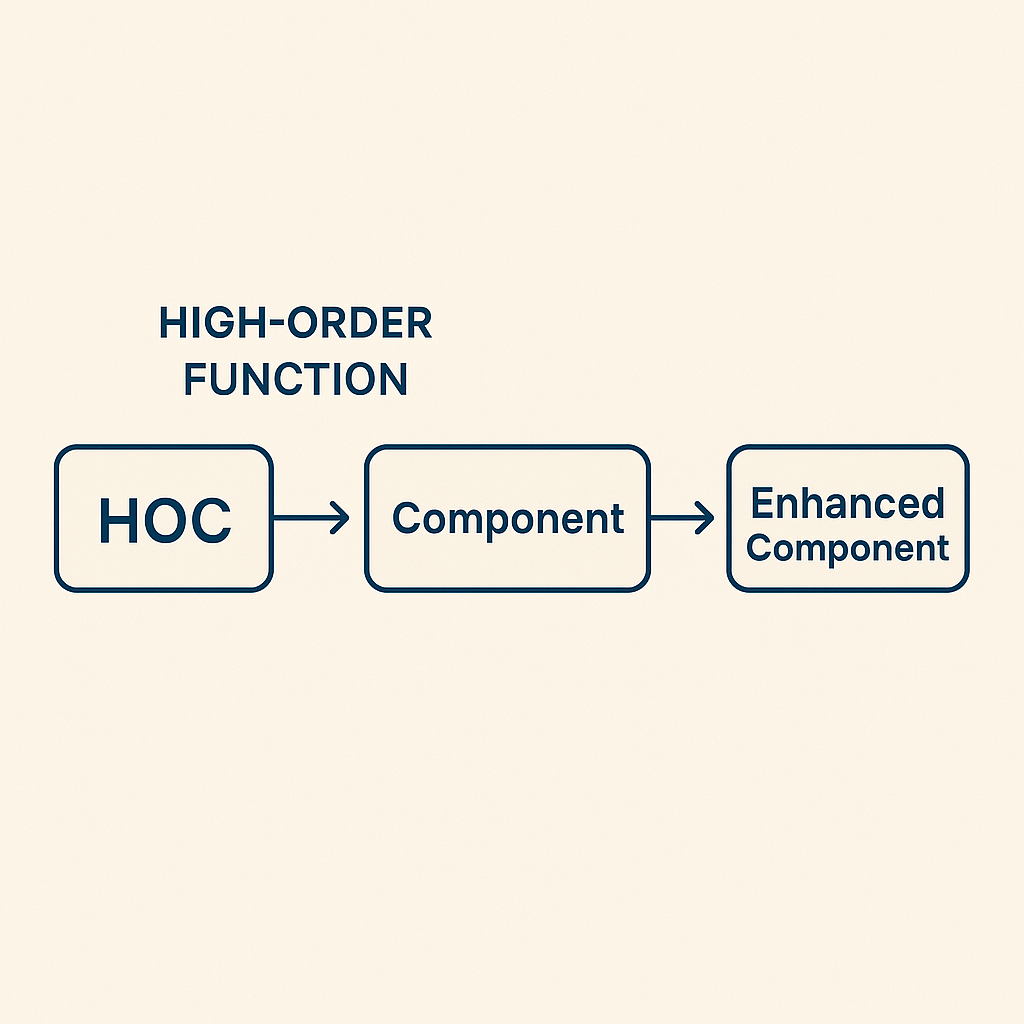
A Higher-Order Component is a function that takes a component and returns a new component with additional props, logic, or structure.
✅ Definition:
const withFeature = (WrappedComponent) => {
  return function EnhancedComponent(props) {
    // add custom logic here
    return <WrappedComponent {...props} />;
  };
};
🧠 The Concept: Higher-Order Function
A higher-order function is one that either:
- Takes another function as an argument, or
- Returns a function
In React, a Higher-Order Component is a higher-order function that wraps a component to add new behavior.
🛠️ Use Case Example: Logging Props
const withLogging = (WrappedComponent) => {
  return function LoggedComponent(props) {
    console.log('Rendering with props:', props);
    return <WrappedComponent {...props} />;
  };
};

// Usage
const MyComponent = (props) => <div>{props.message}</div>;
const MyComponentWithLogging = withLogging(MyComponent);
⚙️ Common Use Cases
- Authorization logic
- Injecting context or global state
- Code reuse across multiple components
- Conditional rendering logic
- Analytics / logging
❗️Important Notes
- HOCs don’t modify the original component—they create a wrapper around it.
- Always preserve props with
{...props}when wrapping. - Use
displayNameto improve debugging:
LoggedComponent.displayName = `WithLogging(${getDisplayName(WrappedComponent)})`;
👎 HOCs vs Hooks
While HOCs are powerful, React Hooks have become the preferred approach in modern applications due to readability and composability. However, HOCs are still relevant in libraries and legacy codebases.
📚 Final Thoughts
Higher-Order Components are a core concept for building abstract and reusable logic in React. They're particularly helpful when you need to apply cross-cutting concerns to multiple components.
Understanding HOCs will not only make your code more modular but will also deepen your grasp of JavaScript's functional nature.
🔥 Want to go further?
- Try building a HOC for user permissions
- Combine HOCs with render props or hooks for advanced patterns