The Full Stack Illusion: Jack of All, Master of None
The Full Stack Illusion: Jack of All, Master of None
Full stack developers are everywhere—from startup teams to job boards promising that magical "one dev to rule them all." But let’s pause for a second.
Is the full stack developer really the expert they’re made out to be?
In most cases… not quite.
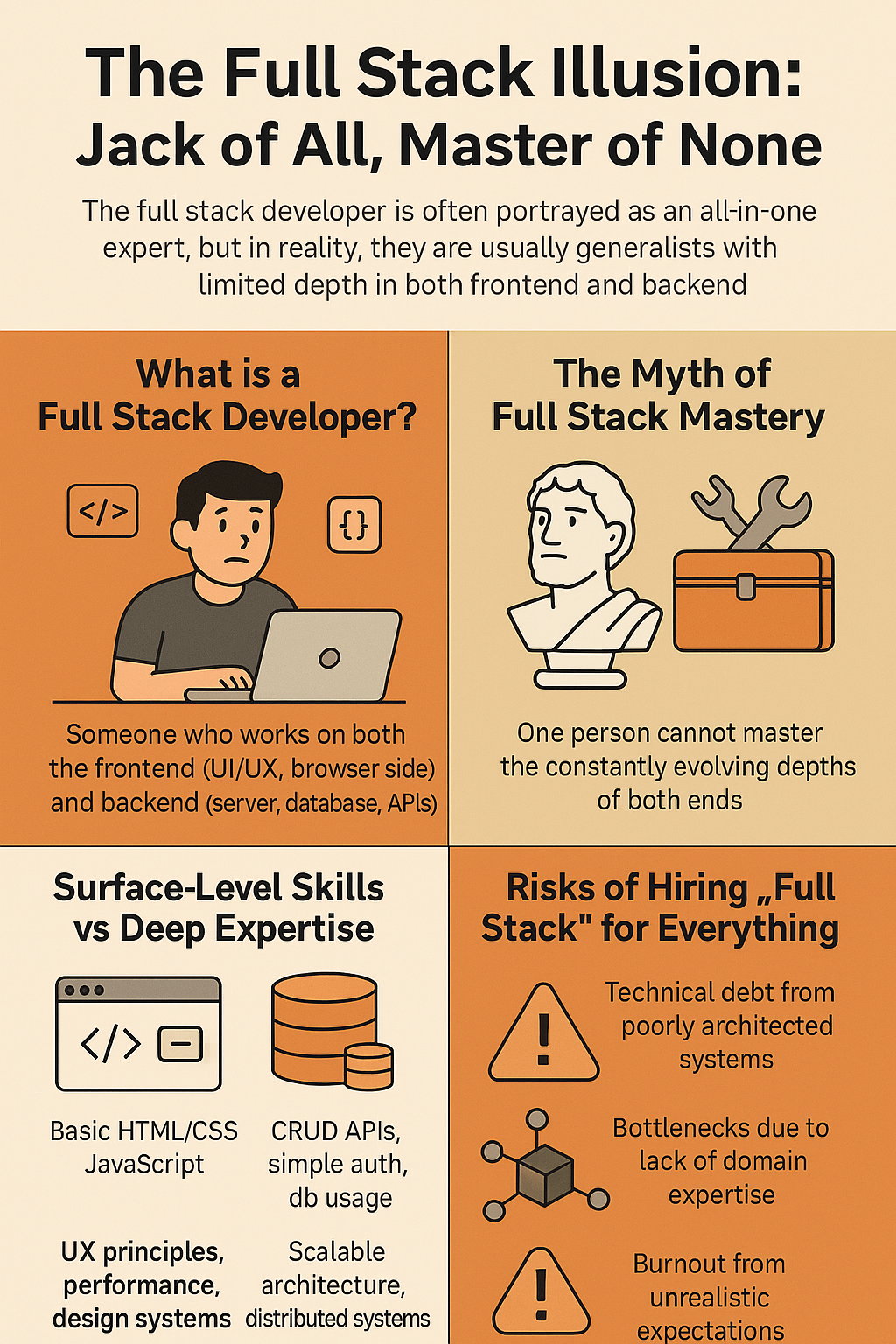
What is a Full Stack Developer?
At its core, a full stack developer is someone who works on both:
- Frontend: The browser side—UI/UX, user interactions, visual design.
- Backend: The server side—databases, APIs, and server logic.
It sounds great on paper. One person who can do it all. But in practice, that breadth often comes at the cost of depth.
The Myth of Full Stack Mastery
Many companies dream of hiring a single developer to build entire platforms from scratch. It saves money. It speeds things up—right?
Well, not necessarily.
The fallacy here is that one person can’t truly master both the frontend and backend, especially given how fast each is evolving.
Think of it like this:
- A general physician can treat common ailments, but for brain surgery, you call a neurosurgeon.
- A handyman can install a shelf, but for rewiring your house, you want a certified electrician.
The same logic applies to software engineering.
Surface-Level Skills vs Deep Expertise
Most full stack developers know just enough to get things working on both ends. For example:
What they usually know:
- Frontend: HTML, CSS, JavaScript, maybe React or Vue
- Backend: Simple APIs, auth flows, CRUD database usage
What they usually lack:
- Frontend: UX design, accessibility, performance optimization, design systems
- Backend: Distributed systems, secure architecture, scalability under load
In many cases, this creates a product that’s functional, but not robust.
The Risks of Hiring “Full Stack” for Everything
While full stack developers can be incredibly useful, relying solely on them for complex products can lead to trouble:
- Technical debt from poorly architected systems
- Bottlenecks due to shallow knowledge in key areas
- Burnout from unrealistic expectations placed on a single person
You don’t want your product held together by duct tape and overworked generalists.
When Full Stack Developers Actually Make Sense
That’s not to say full stack devs are bad hires. In fact, they can be perfect for the right context:
- Startups and MVPs: When you're moving fast and need working prototypes
- Growth-oriented roles: Where devs start broad and specialize over time
- Mentored teams: Where architecture and design decisions are guided by specialists
The key is knowing their limits and setting realistic expectations.
Why Specialization Still Matters
In complex systems, deep expertise pays off:
- Frontend experts know how to craft accessible, fast, and user-friendly interfaces.
- Backend specialists can build scalable, secure, and efficient systems.
Together, they create a solid product. Full stack developers are great collaborators, but depth is what takes software from meh to masterful.
Encourage full stack devs to eventually pick a lane—the one they’re most passionate about—and grow deep roots.
Final Thoughts
The “full stack developer” isn’t a myth—but the idea that they’re experts in both frontend and backend? That’s often just marketing fluff.
They’re flexible. Resourceful. Valuable. But they’re not a silver bullet.
So next time you're hiring, building a team, or thinking about your career path, remember:
Full stack is a starting point—not the destination.