Move the Line — But Only on Evidence
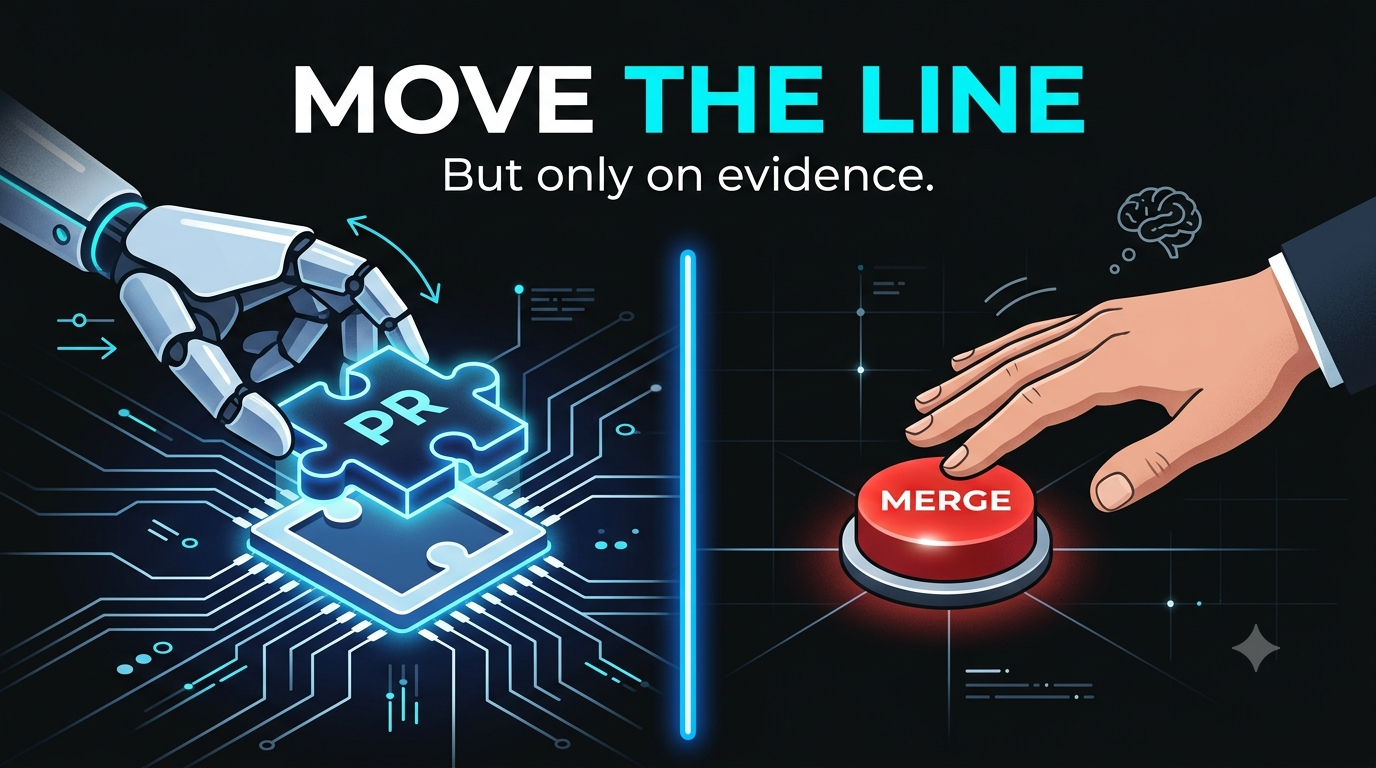
🗞️ Move the Line — But Only on Evidence
Theme of this issue: Two practitioners building with AI at the sharp end say the same thing from different angles: automate the mechanical, protect the judgment. And never move the human out of the loop on vibes alone.
🎯 Hook
An AI agent opened a pull request last week. Nobody asked it to.
It detected the bug, wrote the Jira ticket, cloned the repo, reproduced the failure, and submitted the fix — all before a single engineer touched a keyboard.
And Scott Hanselman, VP at Microsoft, is still telling juniors to learn to drive stick.
Both of them are right.
🔥 Hot Take
💬 My take: The AI enthusiasm crowd wants to remove humans from the loop as fast as possible. The engineers actually building these systems are saying something more interesting: move the line, yes — but earn it with data. Ziccardi's team keeps a human at the merge button not for philosophical reasons, but because every approve or reject is a data point. The loop only expands when the numbers justify it. That's not caution. That's engineering. What most teams are doing instead is moving fast on dopamine and calling it a strategy.
📰 Top Articles
1. Nobody Asked This Agent to Open This Pull Request — It Did Anyway
TL;DR: Marco Ziccardi's team at Voyfai built a fully autonomous 5-stage loop: Datadog detects a production anomaly → agent writes a Jira ticket with evidence → second agent clones the repo, reproduces the bug, opens a PR → third agent handles mechanical review comments → human approves and merges. Zero human initiation required.
My take: The part that deserves attention isn't the automation — it's why the human is still at the end. Not for noble philosophical reasons. Because (1) trust hasn't been earned yet and (2) the human reviewer IS the measurement instrument. Every merge or reject is data on whether the loop is actually solving real problems. The loop only touches well-scoped, clear-signal problems. Ambiguous ones stay human permanently. That boundary isn't a limitation — it's the design.
The key quote: "Removing humans happens on evidence, not vibes. First autonomous merges will be for near-zero-cost, instantly-reversible changes."
2. Scott Hanselman on AI Coding Tools: The Craft Hasn't Changed
TL;DR: VP at Microsoft/GitHub, coding since 1984. ~70% of his code is AI-generated — but it all runs through the same SDLC: code signing, tests, GitHub Actions, Dependabot. His mental model: treat AI like a random anonymous PR contributor. You don't blindly trust the rando on the internet. You don't blindly merge the AI. And AI does NOT generate architecture — it creates god objects and bloated classes. Architecture is still entirely on you.
My take: The Minecraft story says it all. A junior one-shotted a Minecraft clone with the prompt "Make me a clone of Minecraft." Hanselman asked him to do it again without using the word Minecraft. He couldn't. That one word was carrying the entire specification. That's the gap AI exposes — not in code generation, but in the ability to decompose a problem before you have a name for it. Communication clarity IS the fundamental skill. AI makes the gap more visible, not smaller.
The quote that matters: "You've got to drive stick shift — because when your Waymo breaks down, who's changing the tire?"
🔗 The Thread Between Them
Both are saying the same thing from opposite ends of the same system:
- Ziccardi built the loop. He knows exactly where the mechanical ends and where judgment begins — and he enforces that boundary with evidence, not opinion.
- Hanselman reviews the output. He trusts the AI the same way he trusts any unknown contributor: verify before merging.
Neither is anti-AI. Both are anti-autopilot.
The difference between them and most teams right now: they know why the human is where they are in the workflow — and they're measuring whether that position still needs to hold.
💡 Dev Tip of the Week
Steal Ziccardi's framing for your own AI-assisted PR workflow. Start tracking one metric:
How often does a human merge an AI-generated PR unchanged vs. push extra commits on top?
That ratio tells you whether your AI loop is generating useful work or just plausible-looking diffs that waste review time. If you're pushing commits on top of AI output most of the time — your loop isn't ready to expand yet.
🤔 Community Question
❓ When your AI agent opens a PR and your engineer merges it without reading — and it breaks prod — who owns that? Is your team clear on where AI-assisted accountability actually lives?
📌 What I'm Learning / Building
Hanselman runs a 20-year blog on 300MB of XML held in memory. A 1,046-episode podcast on 3 JSON files. 451 personal tools using GitHub issues as the entire database. His question every time he reaches for Postgres: do you actually need Postgres?
I keep thinking about this applied to AI tooling. Every time I reach for an agent loop, the same question applies: do you actually need the agent? Sometimes the right answer is a cron job and a diff.