TypeScript Literal Types: Stop Widening Everything to string
🎯 Hook
Quick test: what's the type of "success" in TypeScript?
If you answered string, you're half right — and that half is where most of us stop thinking about it. TypeScript actually narrows it to the literal type "success", a type with exactly one possible value. Widen it to string the moment you assign it to a variable, and you've thrown away information the compiler was handing you for free.
Literal types are the reason satisfies, discriminated unions, and template literal routes work at all. Understand them properly and a whole category of "why didn't the compiler catch this" bugs stops happening.
🔥 Hot Take
💬 My take: Most TypeScript codebases I've seen use literal types by accident — in a union here, an enum-replacement there — without anyone treating them as a design tool. The teams that get real value out of them are the ones who ask, for every string/number field, "is this actually open-ended, or is it secretly one of five things?" Nine times out of ten in UI state, config, and API contracts, it's the second one. Leaving it as
stringisn't flexibility — it's a bug you haven't hit yet.
📰 Deep Dive: Four Ways to Use Literal Types
1. The basic unit type
A literal type represents a set of exactly one value:
let status: "success" = "success";
// status can only ever be "success" — nothing else compiles
On its own this looks pointless. It becomes useful the moment you union several together:
type RequestStatus = "idle" | "loading" | "success" | "error";

function render(status: RequestStatus) {
  // status is one of exactly four strings — autocomplete works,
  // typos are compile errors, and switch statements can be exhaustive
}
This is the literal-union pattern replacing what used to be a TypeScript enum. It serializes as a plain string (no runtime object), works with plain JS consumers, and plays nicer with template literal types — which is why most current style guides (including the tips repo in my inbox) steer away from enum toward this.
2. as const — narrowing instead of widening
By default, TypeScript widens literals the moment you write them into an object or a let:
const config = { env: "production" };
// config.env is typed as string, not "production"
as const tells the compiler: don't widen, keep every value literal, and make the whole structure readonly.
const config = { env: "production" } as const;
// config.env is typed as "production"

const roles = ["admin", "editor", "viewer"] as const;
type Role = (typeof roles)[number];
// type Role = "admin" | "editor" | "viewer"
That second pattern — deriving a union type from a runtime array with as const + (typeof x)[number] — is one of the highest-value TypeScript idioms I use. One array is now both your runtime source of truth (for a <select>, a validation check) and your compile-time type. No drift between the two.
3. Template literal types — literals with string interpolation
TypeScript 4.1 extended literal types to accept template-string syntax at the type level:
type ArtFeature = "cabin" | "tree" | "sunset";
type Color = "darkSienna" | "sapGreen" | "titaniumWhite";

type PaintMethodName = `paint_${Color}_${ArtFeature}`;
// every combination: "paint_darkSienna_cabin" | "paint_darkSienna_tree" | ...
The practical version of this shows up constantly in routing and API layers:
type ApiRoute = `/api/${string}`;

function fetchRoute(route: ApiRoute) { /* ... */ }

fetchRoute("/api/users");   // ✅
fetchRoute("/users");       // ❌ compile error
TypeScript also ships Uppercase, Lowercase, Capitalize, and Uncapitalize as built-in helpers for transforming string literal types inside template literals — useful for deriving event-name types (on${Capitalize<EventName>}) from a base union.
4. Discriminated unions — literal types as a tag
This is where literal types stop being a syntax trick and start being an architecture decision. A discriminated union uses a literal-typed field as a "tag" that TypeScript can narrow on:
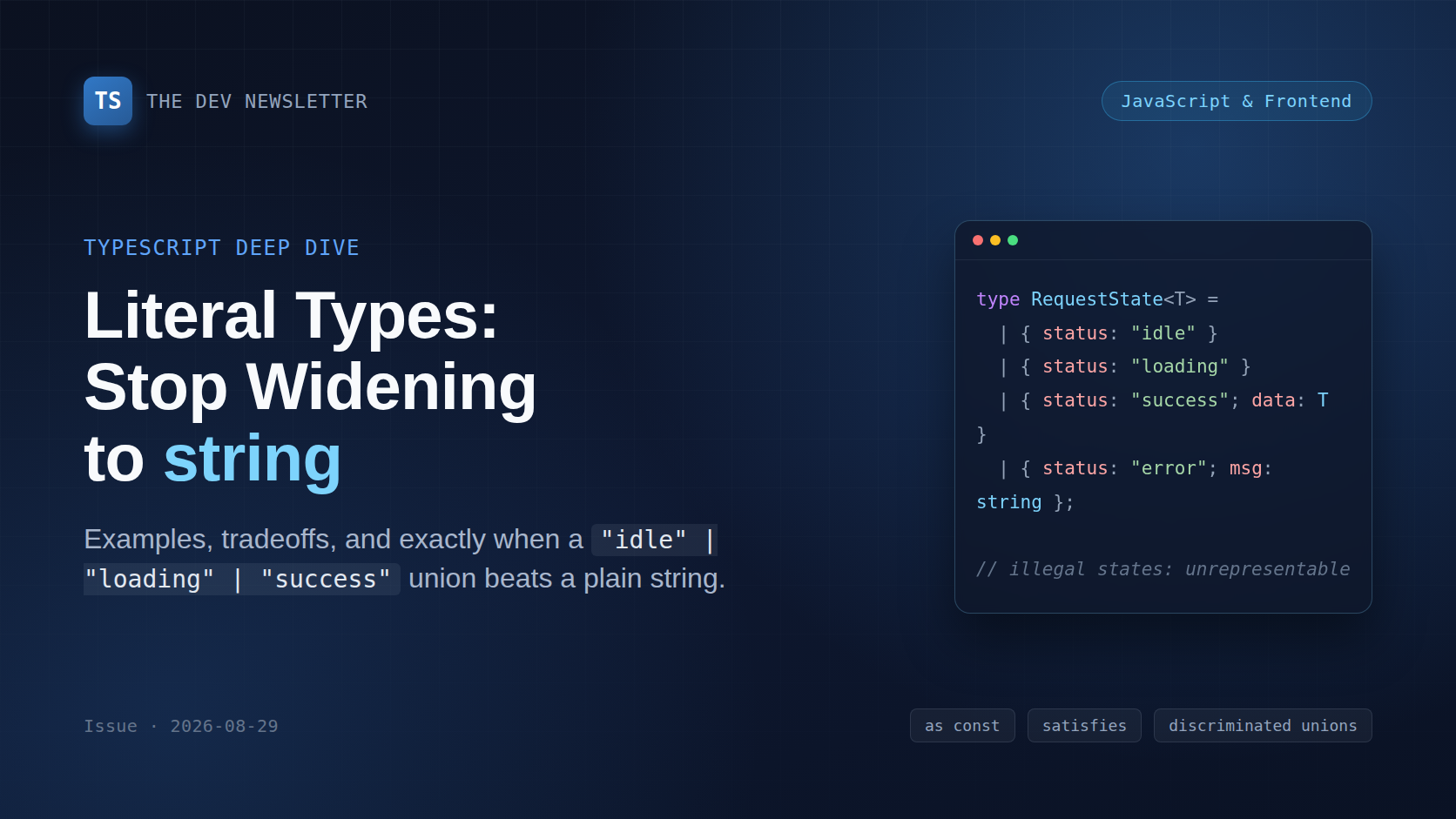
type RequestState<T> =
  | { status: "idle" }
  | { status: "loading" }
  | { status: "success"; data: T }
  | { status: "error"; message: string };

function render<T>(state: RequestState<T>) {
  switch (state.status) {
    case "idle":
      return null;
    case "loading":
      return "Loading…";
    case "success":
      return state.data;      // TS knows `data` exists here — only here
    case "error":
      return state.message;   // TS knows `message` exists here — only here
  }
}
Without the literal-typed status field, data and message would both have to be optional on every branch, and you'd be one missing if away from undefined.something in production. With it, the compiler enforces that you only read data when status is actually "success". Pair it with an exhaustive never check in a default branch and a new state added to the union becomes a compile error everywhere it isn't handled — not a runtime surprise.
⚖️ Where Literal Types Pay Off vs. Where They Don't
| Situation | Literal types | Why |
|---|---|---|
A fixed, known set of states ("idle" | "loading" | "success" | "error") | ✅ Strongly yes | This is exactly the illegal-states-unrepresentable case. Autocomplete + exhaustive checks. |
API response shapes with a type or kind discriminator field | ✅ Strongly yes | Enables discriminated unions — the single highest-leverage use of literal types. |
| Config values from a small, closed set (theme names, roles, env names) | ✅ Yes, via as const | One array becomes both runtime data and the type — no duplication. |
| Route/URL patterns with a fixed prefix or shape | ✅ Yes, via template literal types | Catches malformed routes at the call site instead of at request time. |
| Free-text user input (names, search queries, comments) | ❌ No | There's no finite set — a literal union here is either impossible or a maintenance trap. |
| Values that genuinely change over time (feature flags fetched at runtime, dynamic keys from an external system) | ⚠️ Careful | A literal union hardcodes a snapshot. If the source of truth lives outside your code, the type will drift and lie to you. Validate at the boundary instead (Zod/similar), don't fake certainty with a union. |
| IDs, timestamps, anything with effectively unbounded values | ❌ No | Widen to string/number. A "literal type" of every possible UUID isn't a type, it's noise. |
| A single call site that only ever passes one value | ⚠️ Usually skip | Technically valid, but if nothing else in the codebase depends on the narrowing, you're adding ceremony for no payoff. |
The one rule underneath the table: literal types are worth it exactly when the set of valid values is finite, known at compile time, and something you want the compiler to enforce elsewhere in the codebase. If any of those three is false, you're forcing a tool to do a job it isn't suited for.
💡 Dev Tip of the Week
satisfies over as when you want literal narrowing and validation.
// ❌ `as` — no validation, and widens on read
const config = {
  env: "production",
  retries: 3,
} as { env: string; retries: number };

// ✅ `satisfies` — TypeScript checks the shape against the type,
// but keeps the literal types instead of widening them
const config = {
  env: "production",
  retries: 3,
} satisfies { env: "production" | "staging"; retries: number };

// config.env is still "production", not string — autocomplete and
// narrowing downstream both still work
as is a cast — you're telling the compiler to trust you, no questions asked. satisfies is a check — the compiler verifies your object actually matches the type, then lets you keep the more specific inferred type instead of forcing the wider annotation on you. If you're reaching for as to make an object match a type, try satisfies first.
🤔 Community Question
❓ Where's the line for you — at what point does a literal union stop being "type safety" and start being "maintenance overhead"? Curious if anyone's had a literal union grow so large it became the wrong call in hindsight.
📌 What I'm Learning / Building
Going back through Effective TypeScript and the Frontend Masters TypeScript courses this month, specifically the sections on narrowing and variance — literal types keep showing up as the foundation under features that look unrelated on the surface (satisfies, discriminated unions, exhaustive checks, template literal routes). Worth treating as core knowledge, not a corner case.